
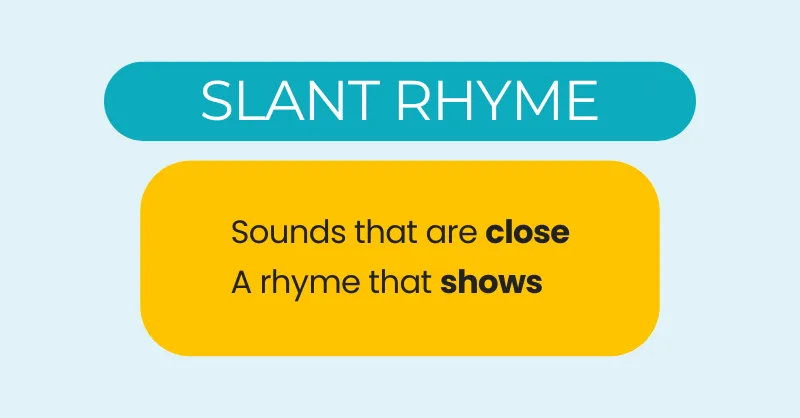
Slant rhyme, also known as Near Rhyme, is the use of words that share similar vowel or consonant sounds but do not form a perfect phonetic match.
In modern songwriting, slant rhyme is often preferred over perfect rhyme because it sounds more natural, less predictable, and allows for a much wider range of lyrical expression.
Slant rhyme is a textural device. While a rhyme scheme (like ABAB) tells you where to rhyme, slant rhyme determines the quality of the sound used in those positions.
- Perfect Rhyme: The vowel sounds and all subsequent sounds are identical (e.g., cat and hat, sky and high).
- Slant Rhyme: The sounds are close enough to “feel” like a rhyme without being identical (e.g., bridge and grudge, orange and storage).
The Function and Effects of Slant Rhyme
Slant rhyme is the primary tool used by modern songwriters to avoid the “nursery rhyme” effect of overly simple, predictable pairings.
Increased Creative Freedom
Perfect rhymes are limited. There are only so many words that rhyme perfectly with “love” or “heart.”
Slant rhymes open up thousands of new word combinations, allowing songwriters to say exactly what they mean rather than being forced into a cliché just to make a rhyme work.
Modern and Conversational Tone
In contemporary music, perfect rhymes can sometimes sound dated or “theatrical.”
Slant rhymes mimic the way people actually speak, giving the lyrics a grittier, more authentic, and sophisticated feel.
Subtle Tension
Because a slant rhyme doesn’t provide the perfect “click” of a full rhyme, it creates a slight sense of unresolved tension.
This can be used to mirror feelings of unease, longing, or complexity in a song’s narrative.
Types of Slant Rhyme
Songwriters generally use two specific phonetic techniques to create slant rhymes:
1. Assonance (Vowel Rhyme)
This occurs when the internal vowel sounds match, but the ending consonants do not. This is the most common type of slant rhyme in pop and hip-hop.
Example: “Pen” and “Shed”
2. Consonance
This occurs when the ending consonant sounds match, but the internal vowel sounds are different.
Example: “Bend” and “Sand“
Slant Rhyme Examples in Music
Below are examples of how songwriters use slant rhyme to create memorable lyrics.
Example 1: “The One That Got Away” by Katy Perry


This is a great example of a slant rhyme that matches the “e” vowel sound.
Summer after high school, when we first met
We’d make out in your Mustang to Radiohead
Example 2: “Lose Yourself” by Eminem
Eminem is a master of stacking slant rhymes by matching vowel sounds across multiple words. This is also an example of multiple internal rhymes.
His palms are sweaty, knees weak, arms are heavy
There’s vomit on his sweater already, mom’s spaghetti
Related: “Lose Yourself” Song Meaning
Example 3: “HUMBLE.” by Kendrick Lamar
Kendrick Lamar has a knack for creating unique slant rhymes in his tracks.
I’m so fu**in’ sick and tired of the Photoshop
Show me somethin’ natural like afro on Richard Pryor
Example 4: “Fire and Rain” by James Taylor
James Taylor uses slant rhyme in this classic folk hit.
I’ve seen lonely times when I could not find a friend
But I always thought that I’d see you again
Related: “Fire and Rain” Song Meaning
Example 5: “Paper Planes” by M.I.A.
This one is the closest to a perfect rhyme, but the lines end in different consonant sounds.
I fly like paper, get high like planes
If you catch me at the border, I got visas in my name
Related: Best Songs About Money
Tips for Using Slant Rhyme in Songwriting
When incorporating slant rhyme, use these strategies to keep your lyrics sounding professional:
Focus on the Vowels
The ear is much more forgiving of different consonants if the vowel sounds (assonance) are strong.
If you’re stuck on a rhyme, try matching the “shape” of the vowel sound rather than the whole word.
Emotional Complexity
If your song is about something stable and happy, perfect rhymes can emphasize that stability.
If your song is about heartbreak, confusion, or anger, slant rhymes can subtly reinforce that lack of “perfect” resolution.
Mix Perfect and Slant Rhymes
You don’t have to choose one or the other.
Many songwriters use perfect rhymes in the chorus to make the hook “stick” more easily, while using slant rhymes in the verses to allow for more detailed storytelling.
Key Takeaways
- Slant rhyme uses words with similar but not identical sounds to create a rhyme.
- It is a textural tool that provides more creative freedom and a modern sound.
- Most slant rhymes rely on Assonance (vowel sounds) or Consonance (consonant sounds).
- It helps songwriters avoid clichés and create a more conversational, authentic tone.
Related Guides
Internal rhyme and slant rhyme are often used together to create dense, modern flows. To see how these techniques interact with other structures, check out these articles:
- Internal Rhyme: Learn how to place rhymes within a line to increase momentum and density.
- Rhyme Schemes Index: View all of the most popular rhyme schemes and structural techniques used in music.
Lyric Stories Newsletter
Don’t miss out on our latest song interpretations and curated music lists!