
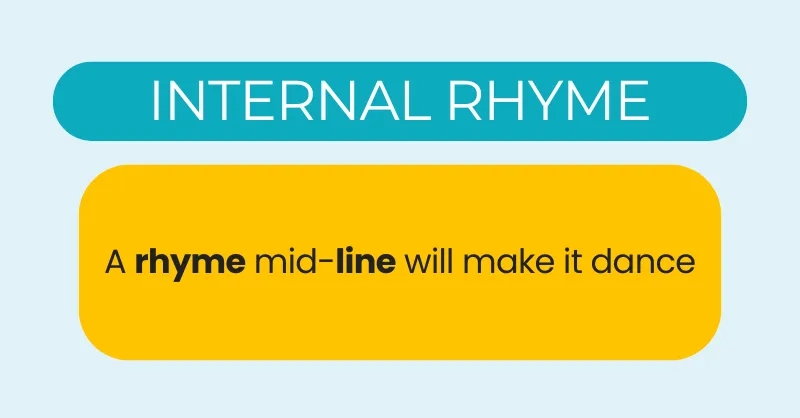
Internal rhyme is the rhyming of two or more words within the same line of a lyric, or when a word in the middle of one line rhymes with a word in the middle or end of the next line.
Internal rhyme is a textural device, not a structural one. It does not define where a stanza ends, but rather describes how tightly the words are woven together as they are sung or spoken.
- End Rhyme: Defines the overall structure of a song (AABB, ABAB, etc.).
- Internal Rhyme: Adds density, momentum, and musical detail within that structure.
The Function and Effects of Internal Rhyme
Internal rhyme is used to add musical complexity and control the pace of a lyric.
Pacing and Speed
Internal rhyme often increases the lyrical speed and rhythm of a song.
When words within a line rhyme, the listener’s ear is pushed quickly from one word to the next, making the line feel dense and fast.
This is why the technique is commonly found in highly rhythmic genres like hip-hop.
Emphasis and Highlight
A rhyme naturally draws the listener’s attention.
By placing a rhyme mid-line, the technique forces emphasis onto that specific word, often highlighting a key action, image, or concept.
Flow
Internal rhymes connect the words within a single line (or across two), creating a tight, continuous chain of sound.
This gives the lyric a “flow” that enhances the overall musical presentation.
Types of Internal Rhyme
Internal rhyme generally falls into two categories based on the position of the rhyming words:
1. Single-Line Internal Rhyme
This type occurs when two or more words within the same line share a rhyming sound.
“The cat sat on a mat near the fire.”
2. Inter-Line Internal Rhyme (Cross Rhyme)
This occurs when a word in the middle of one line rhymes with a word in the middle or at the end of the following line.
“The air grew dark, a terrible sound / We saw the spark fall to the ground.”
Internal Rhyme Examples in Music
Below are some examples of popular songs that use internal rhyme.
Example 1: “Lose Yourself” by Eminem


Eminem is well-known for his internal rhymes. This is just one example in “Lose Yourself.”
He’s nervous, but on the surface, he looks calm and ready
Related: “Lose Yourself” Song Meaning
Example 2: “Hey Jude” by The Beatles
The Beatles’ classic has an inter-line internal rhyme to start the song.
Hey, Jude, don’t make it bad
Take a sad song and make it better
Related: “Hey Jude” Song Meaning
Example 3: “Like a Rolling Stone” by Bob Dylan
Dylan loved to use internal rhymes in his early stuff, and there are some great ones in the opening verse of this legendary track.
People call, say “Beware, doll, you’re bound to fall“
Related: “Like a Rolling Stone” Lyrics Meaning
Example 4: “Rapper’s Delight” by Sugarhill Gang
This is an example of internal rhyme found in the middle of a song. This is from the second verse of “Rapper’s Delight.”
You see I’m six foot one and I’m tons of fun and I dress to a tee
Example 5: “Simon Says” by Pharoahe Monch
Pharoahe Monch is another hip-hop artist known for his internal rhymes. Here’s one from the chorus of his biggest hit.
Brooklyn in the back shooting craps now, what’s up?
Example 6: “Anxiety” by Doechii
This is a great example of a modern song that uses both types of internal rhymes.
Money on my jugular, natural hustler
Think I need a smuggler up in Russia
Related: “Anxiety” Song Meaning
Example 7: “Subterranean Homesick Blues” by Bob Dylan
Had to include one more Dylan since “Subterranean Homesick Blues” has a bunch of great internal rhymes to end the song.
Better jump down a manhole, light yourself a candle
Don’t wear sandals, try to avoid the scandals
Don’t want to be a bum, you better chew gum
The pump don’t work ’cause the vandals took the handles
Tips for Using Internal Rhyme in Songwriting
When incorporating internal rhyme into your lyrics, keep these core applications in mind to maximize its effect:
Control Your Flow and Pacing
Use internal rhyme to manage the rhythmic momentum of your verse.
A line dense with internal rhymes will create a surge in pace and energy. Balance this by following it with a simpler, slower line to control the listener’s journey through the lyric.
Prioritize Assonance and Consonance
In music, a perfect internal rhyme can sometimes feel forced or overly simple.
Using similar vowel sounds (assonance), such as light and time, or shared consonant sounds (consonance), like stand and stood, adds texture instead.
These techniques help the lines flow more naturally and can enhance the song without relying entirely on perfect rhymes.
Use for Emphasis, Not Structure
Internal rhyme is a high-energy tool. Unless you’re writing in a genre built on dense flow (like hip-hop), reserve this technique for the one or two lines that need to deliver the strongest emotional or narrative punch.
Save its power for key moments rather than trying to sustain it throughout an entire section of your song.
Key Takeaways
Here are the essential points regarding the structure and utility of internal rhyme:
- Internal rhyme occurs when a word within a line rhymes with another word in the same line, or with a word in the following line
- Its primary effect is to increase rhythmic density and forward momentum.
- Internal rhyme is a textural tool used to emphasize specific words or moments, not to organize a song’s structure.
Related Guides
Internal rhyme is often used to enhance or disrupt standard structural patterns. To see how this technique works within specific schemes, check out these articles:
- AABB: Learn about the most common structural building block in music, the back-to-back couplet.
- ABAB: See how an alternating pattern creates a different sense of progression and resolution.
- Rhyme Schemes Index: View all of the most popular rhyme schemes and structural techniques used in music.
Lyric Stories Newsletter
Don’t miss out on our latest song interpretations and curated music lists!