
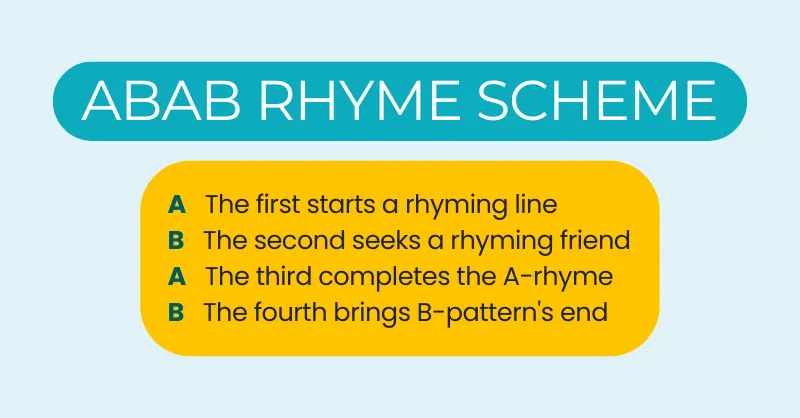
The ABAB rhyme scheme, often called the alternating or interlaced rhyme, is one of the most classic and versatile four-line structures in all of poetry and lyric composition.
ABAB allows for a more sustained, thoughtful, and poetic sound compared to simple schemes, delaying the rhyme to create momentum.
- The first line ends with the A sound.
- The second line ends with the B sound.
- The third line ends with the A sound (rhyming with Line 1).
- The fourth line ends with the B sound (rhyming with Line 2).
This structure ensures that the two couplets are “interlaced” rather than paired, unlike the paired rhyme of the AABB scheme.
Rhyme Clarification: While using perfect rhymes for both the A and B sounds provides the clearest structure, many songwriters utilize near rhymes (or slant rhymes) in one or both pairs. This gives the verse a looser, more natural flow, making it less predictable than a strict AABB pattern.
The Function and Effects of ABAB
The primary effects of using the ABAB scheme center on sophistication, flow, and emotional depth.
While simple structures like AABB drive a clear, quick point home, ABAB is used when a writer needs to develop a complete idea or image over the full span of four lines.
Sustained Momentum and Anticipation
The biggest structural benefit of the alternating rhyme is that it creates sustained momentum and anticipation.
The delay of the ‘A’ rhyme until the third line forces the reader or listener to carry the idea forward, drawing them through all four lines of the unit.
The fourth line then neatly resolves the second idea, resulting in a continuous, flowing feel.
Elegance and Poetic Weight
The delayed and interlaced nature of ABAB creates a smooth, polished sound.
It is closely associated with traditional poetry and carries a slightly more formal, thoughtful feel than other schemes.
Where ABAB Is Used
ABAB is strongly present in writing that favors narrative and depth, such as traditional ballads, hymns, sonnets, and lyrical poetry, where storytelling or sustained emotional development is key.
ABAB Rhyme Scheme Examples
Below are examples of ABAB in music and poetry.
Example 1: “April Showers” by Al Jolson


Jolson’s Broadway classic uses the ABAB scheme in the opening verse.
Life is not a highway strewn with flowers (A)
Still it holds a goodly share of bliss (B)
When the sun gives way to April showers (A)
Here is the point you should never miss (B)
Example 2: “Amazing Grace”
Everyone knows this one. “Amazing Grace” is perhaps the most well-known ABAB.
Amazing Grace, how sweet the sound (A)
That saved a wretch like me (B)
I once was lost but now I’m found (A)
Was blind, but now I see (B)
Example 3: Sonnet 18 by William Shakespeare
Shakespeare’s famous sonnet includes ABAB rhymes throughout.
Sometime too hot the eye of heaven shines (A)
And often is his gold complexion dimm’d (B)
And every fair from fair sometime declines (A)
By chance or nature’s changing course untrimm’d (B)
Example 4: “Scarborough Fair”
This traditional folk tune includes an alternating rhyme in the opening verse.
Are you going to Scarborough Fair? (A)
Parsley, sage, rosemary, and thyme (B)
Remember me to one who lives there (A)
She once was a true love of mine (B)
Example 5: “Do It Again” by Steely Dan
Steely Dan’s soft rock hit has ABAB rhymes in each verse.
When you know she’s no high climber (A)
Then you find your only friend (B)
In a room with your two timer (A)
And you’re sure you’re near the end (B)
Related: “Do It Again” Song Meaning
Example 6: “Azizam” by Ed Sheeran
This 2025 pop song has ABAB rhymes in each verse. The A-rhyme below is a slant rhyme.
I wanna be nowhere but here with you now (A)
I wanna be one in this space (B)
I wanna be tangled and wrapped in your cloud (A)
I wanna be close to your face (B)
Related: “Azizam” Song Meaning
Tips for Using Alternating Rhyme in Songwriting
To effectively use the ABAB scheme in your own songs, focus on maximizing its natural strength: narrative development, emotional complexity, and musical flow.
- Narrative Flow: When you have a story to tell or a complex argument to make, ABAB is your best tool. The structure organically forces you to develop the idea across four lines, preventing the two-line “stop-and-start” feeling of AABB.
- Sophistication: Choose ABAB when your material calls for a more poetic or less rhythmically heavy feel. It pairs well with compositions that are acoustic, melodic, or lyrically focused.
- Master the End Rhymes: Since the rhyme is delayed, your rhyming words (A and B) must be strong and intentional. Weak end words will make the whole four-line unit feel anticlimactic.
- Avoid the “Cliché” Trap: Use varied rhythm within the four lines, and consider employing slant rhymes to avoid sounding too much like a predictable nursery rhyme.
Key Takeaways
Here are the essential points regarding the structure and utility of the ABAB rhyme scheme:
- The ABAB rhyme scheme creates a four-line structure where the rhymes are separated and interlaced (A-B-A-B).
- Its main function and effect is to create sustained momentum, forcing the reader or listener through the full four lines for resolution.
- ABAB adds depth to a song, making it ideal for narrative and thoughtful tracks.
Related Guides
The ABAB scheme adds a sense of progression and balance by alternating sounds. To see how this compares to simpler patterns or how it can be enhanced, check out these articles:
- AABB: See how the alternating flow of ABAB compares to the simpler, back-to-back resolution of the traditional couplet.
- Internal Rhyme: See how artists use rhymes inside the lines to enhance the melodic flow of their songs.
- Rhyme Schemes Index: View all of the rhyme schemes used in music.
Lyric Stories Newsletter
Don’t miss out on our latest song interpretations and curated music lists!