
Ever wonder why some songs just “work” while others feel a bit messy? It usually comes down to how the different pieces are put together.
Here is a breakdown of the building blocks you’ll find in almost every hit on the radio.
The Verse
Think of the verse as the storytelling section of the song. This is where the songwriter gives you the details, the plot, and the background. While the music usually stays the same in every verse, the words change to keep the story moving forward.
- Example: In “Fast Car” by Tracy Chapman, the verses are where we learn all the specific details about her life and her plan to get away.
The Pre-Chorus
The pre-chorus is that short “climb” that builds up excitement right before the big payoff. Its whole job is to create a bit of tension and make the listener crave the chorus. You’ll usually feel the energy or the volume start to rise here.
- Example: In “Firework” by Katy Perry, the “You just gotta ignite the light…” part is the classic climb that makes the chorus feel so much bigger when it finally hits.
The Chorus
The chorus is the heart of the song and the part everyone remembers. It’s the emotional peak, usually contains the song’s title, and stays exactly the same every time it comes around so people can sing along.
- Example: The chorus section of “I Will Always Love You” by Whitney Houston is the ultimate example of a chorus that defines a song.
The Post-Chorus
A post-chorus is a little extra “bonus” hook that keeps the energy high after the main chorus is over. It’s usually shorter and might just be a catchy melody, a repeated phrase, or a cool instrumental bit that keeps you from dropping back into a quiet verse too quickly.
- Example: In “Levitating” by Dua Lipa, the “You can fly away with me tonight” part right after the chorus is what keeps the dancefloor moving.
The Hook
A hook is simply the “earworm,” a specific bit of the song that gets stuck in your head for days. While a lot of people think the chorus is the hook, a hook can actually be anything: a cool guitar riff, a unique drum beat, or a signature vocal “ooh.”
- The Difference: The chorus is a full section of the song, but the hook is the specific moment that makes the song addictive.
The Bridge
The bridge is there to break up the pattern and give the song a totally new direction. It usually shows up about two-thirds of the way through to keep things from getting boring. It often has a different melody or a new perspective that “bridges” the gap between the second and final chorus.
- Example: In “Every Breath You Take” by The Police, the mood shifts completely during the “Since you’ve gone, I’ve been lost without a trace” section, and that’s the bridge.
The Refrain
A refrain is a short, recurring line that usually “anchors” the end of a verse. People often mix these up with choruses, but a refrain is much smaller and is tucked inside the verse rather than being its own big, separate section.
- Example: In “The Times They Are A-Changin’” by Bob Dylan, the title line at the end of every verse acts as the refrain.
The Outro (Coda)
The outro is how the song says goodbye and wraps things up. Some songs use a “fade out” where the volume slowly disappears, while others have a big, unique finale that sounds different from everything else in the track.
- Example: The long, legendary “Na-na-na-na” ending of “Hey Jude” by the Beatles is a perfect example of a song that has a massive, memorable outro.
Common Song Structures
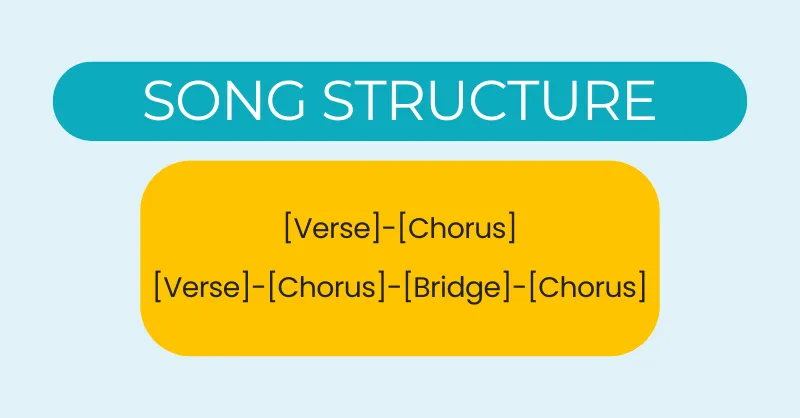
- Classic Pop Structure: Verse – Chorus – Verse – Chorus – Bridge – Chorus
- Modern Pop Structure: Intro – Verse – Pre-Chorus – Chorus – Post-Chorus – Verse – Pre-Chorus – Chorus – Post-Chorus – Bridge – Chorus – Outro
Lyric Stories Newsletter
Don’t miss out on our latest song interpretations and curated music lists!