
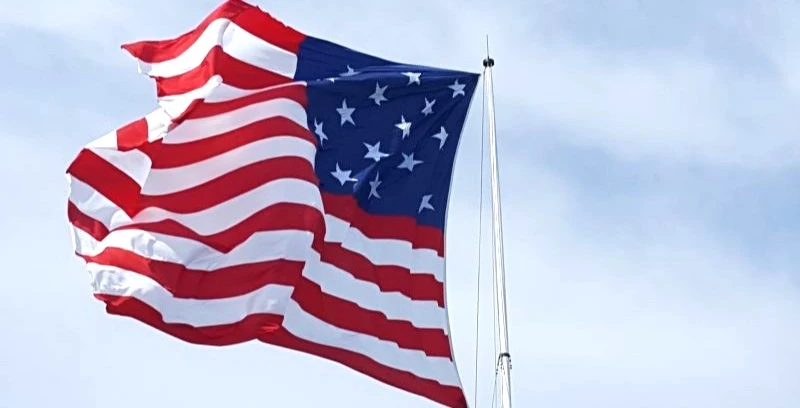
Written in 1814 by Francis Scott Key, “The Star-Spangled Banner” is based on a poem called “Defence of Fort M’Henry.” Key wrote it after watching the British bombard Fort McHenry during the War of 1812.
The poem has four verses, but only the first verse and chorus are typically sung as the national anthem. It’s really just one verse, but it’s usually broken up into verse lines and chorus lines when in song form. Below is a breakdown of those sections of “The Star-Spangled Banner.”
- Song: Star-Spangled Banner
- Songwriters: Francis Scott Key, John Stafford Smith
- Released: 1814
What is “The Star-Spangled Banner” About?
Verse 1: Watching Through the Night
O say can you see by the dawn’s early light
What so proudly we hailed at the twilight’s last gleaming?
Key is asking a question. Can you see the American flag in the early morning light, the same flag that he saw flying at dusk the night before?
He was being held captive by the British on a ship during the battle. From there, he watched Fort McHenry get bombarded through the night.
Whose broad stripes and bright stars through the perilous fight
O’er the ramparts we watched, were so gallantly streaming?
He’s describing the flag (stripes and stars) and asking if it’s still waving over the fort’s walls after the battle.
“Streaming” refers to the flag still flying over the fort’s walls during the battle.
If the flag was still up, it meant the Americans held the fort. If it was down, it meant surrender.
And the rocket’s red glare, the bombs bursting in air
Gave proof through the night that our flag was still there
The British ships fired rockets and bombs at the fort. The explosions lit up the night sky.
The light from the explosions was the only way Key could see anything in the dark.
Every time a bomb burst, he could check if the flag was still standing. As long as it was there, the Americans were still fighting.
Lyric Stories Newsletter
Don’t miss out on our latest song interpretations and curated music lists!
Chorus: Does It Still Wave?
O say does that star-spangled banner yet wave
O’er the land of the free and the home of the brave?
This is the big question. Is the flag (the Star-Spangled Banner) still up and waving over America?
I have to assume that many people don’t realize this chorus is a question because they’ve only heard it sung, and the song makes it seem like a statement.
The question mark changes everything. Key was asking if they’d won, not declaring victory.
The answer was yes. When morning came, the smaller Storm Flag used during battle was replaced with the massive Garrison Flag to signal the American victory. That’s the flag Key saw, and that’s what inspired him to finish the poem.
“The Star-Spangled Banner” Song Meaning: Waiting for Dawn
“The Star-Spangled Banner” is about the anxiety of not knowing if your side won until morning comes. Key watched the bombardment all night from a British ship, unable to do anything but wait and watch for the flag. Every explosion gave him a glimpse of whether it was still standing.
The song is framed as questions because that’s what he was experiencing. He didn’t know if the fort had fallen. He didn’t know if the flag would still be there at dawn. The entire night was spent in suspense, waiting for enough light to see the outcome.
When the sun rose and he saw that huge Garrison Flag flying, he knew the Americans had held the fort. That moment of relief and pride became the foundation of the national anthem.
Conclusion: Understanding the Anthem
It’s interesting to read the lyrics to “The Star-Spangled Banner” for the first time in years and re-remember the real meaning. Its power comes from its uncertainty rather than its confidence, which is hard to pick up when you hear it sung.
It begins with darkness, explosions, and questions about whether the fort and the flag survived the night. Only when morning light reveals the flag still flying does the tone shift toward pride and relief.
Remembering that progression helps explain why the anthem feels both tense and triumphant.
