
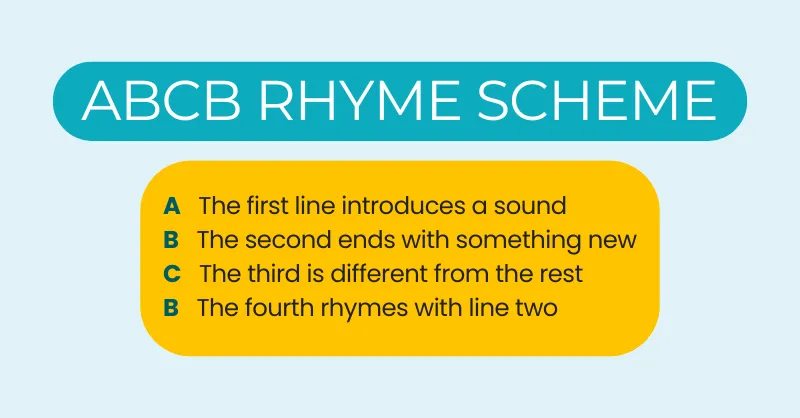
The ABCB rhyme scheme, also known as the Ballad Rhyme, is one of the most common and versatile rhyme schemes in music. It can give a song a relaxed, conversational feel.
ABCB rhymes only the second and fourth lines while leaving the first and third lines “open”:
- The first line ends with the A sound.
- The second line ends with the B sound.
- The third line ends with the C sound.
- The fourth line ends with the B sound.
Because only half the lines are required to rhyme, ABCB allows for more natural phrasing and storytelling than the more restrictive AABB or ABAB patterns.
The Function and Effects of ABCB
The ABCB scheme is prized for its flexibility. It mirrors the cadence of natural speech more closely than other schemes, making it ideal for narrative-heavy lyrics that sound like a natural statement rather than a forced rhyme.
Flexibility
By not rhyming the first and third lines, the writer has more freedom to choose words based on their meaning rather than their sound. This makes it easier to deliver complex ideas without the lyrics feeling forced or “rhyme-heavy.”
Delayed Gratification
Unlike a couplet (AABB), which resolves immediately, ABCB makes the listener wait for the fourth line to hear the resolution. This creates a subtle sense of anticipation.
Genre Versatility
ABCB is the standard for folk music, country storytelling, and power ballads. It is also a staple in hymns and protest songs because the structure stays out of the way of the message.
ABCB Rhyme Scheme Examples in Popular Music
Below are six examples of ABCB used in well-known songs and poems.
Example 1: “Fast Car” by Tracy Chapman


This verse from Chapman’s hit is a great example of how an ABCB song can feel like the artist is having a real conversation.
You got a fast car (A)
I want a ticket to anywhere (B)
Maybe we make a deal (C)
Maybe together we can get somewhere (B)
Related: “Fast Car” Song Meaning
Example 2: “Roses are Red”
This classic children’s rhyme is one of the most well-known examples of the ABCB rhyme scheme.
Roses are red (A)
Violets are blue (B)
Sugar is sweet (C)
And so are you (B)
Example 3: “For the First Time” by Mac DeMarco
This verse in DeMarco’s 2017 hit is a great example of the ABCB rhyme scheme in modern pop.
While she’s been away (A)
Living day-to-day has been tough (B)
Without her at my side (C)
Simply being alive’s been rough (B)
Related: “For the First Time” Song Meaning
Example 4: “Somewhere Over the Rainbow” by Judy Garland
Each verse in this classic The Wizard of Oz tune uses ABCB.
Somewhere over the rainbow (A)
Skies are blue (B)
And the dreams that you dare to dream (C)
Really do come true (B)
Related: “Somewhere Over the Rainbow” Song Meaning
Example 5: “Itsy Bitsy Spider”
You can easily recognize the ABCB scheme in this nursery rhyme.
The itsy bitsy spider (A)
Climbed up the waterspout (B)
Down came the rain (C)
And washed the spider out (B)
Example 6: “Me and Julio Down by the Schoolyard” by Paul Simon
Paul Simon’s use of ABCB here makes it easier for the listener to follow the story.
The mama pajama rolled out of bed (A)
And she ran to the police station (B)
When the papa found out, he began to shout (C)
And he started the investigation (B)
Related: “Me and Julio Down by the Schoolyard” Song Meaning
Tips for Using ABCB in Your Lyrics
If you are writing lyrics, use the tips below to maximize the impact of the ABCB scheme.
- Focus on the Story: Use ABCB when the narrative is more important than the rhyme. The “open” lines (A and C) allow you to use specific, impactful words that don’t have many rhyme partners.
- Bridge the Gap: If you find that an AABB scheme feels too childish or “sing-songy” for a serious topic, switching to ABCB can make the lyrics feel more mature and thoughtful.
- Combine with Internal Rhyme: Because ABCB has fewer end-rhymes, it provides plenty of space to use internal rhymes without the verse or chorus becoming over-cluttered.
Key Takeaways
- Narrative Strength: The best scheme for storytelling and folk-style lyrics.
- Natural Cadence: Closely mimics human speech and conversation.
- Subtle Resolution: Creates a gentle “pull” toward the final rhyming line.
Related Guides
To see how the ABCB pattern compares to other structures or to find more complex forms, check out these related guides:
- AABB: See how the back-to-back couplet creates a more driving, predictable rhythm compared to the relaxed ABCB.
- ABAB: Compare ABCB to the full alternating rhyme, which provides more frequent resolution.
- Rhyme Schemes Index: View the full catalog of the most common rhyme schemes used in music.
Lyric Stories Newsletter
Don’t miss out on our latest song interpretations and curated music lists!